Games Management System (GMS)
The backbone of modern sports event management - designed to meet Olympic standards.
The Games Management System (GMS) is the backbone of modern sports event management - an intelligent, end-to-end digital ecosystem designed to meet Olympic standards. It seamlessly integrates operational, administrative, and competition-related functions into one cohesive framework, ensuring transparency, efficiency, and accountability throughout the event lifecycle.
At its core, the GMS serves as the central nervous system of any championship or multi-sport event, automating and optimizing critical processes.
- Athlete & Team Registration - secure onboarding, verification, and accreditation.
- Competition Scheduling & Management - scientifically aligned with venues, logistics, and officials.
- Accreditation & Access Control - role-based permissions for athletes, officials, media, and VIPs.
- Timing, Scoring & Results (TSR) - real-time delivery of results, rankings, and statistics.
- Volunteer & Workforce Management - efficient deployment, task allocation, and tracking.
- Medical & Anti-Doping Management - full compliance with international standards.
- Media & Broadcasting Integration - live results, press operations, and digital platforms.
- Technology & Infrastructure Coordination - venue readiness, connectivity, and IT assets.
Its strength lies in interdependent functional integration: schedules link with transport and accommodation, accreditation ties into security, and results connect directly to media and broadcast systems. This synchronization transforms large-scale events from fragmented silos into unified, agile ecosystems.
Incorporating 16 core functional areas, the GMS delivers real-time dashboards, monitoring tools, and audit-ready reports - empowering organizers to make fast, data-driven decisions and adapt seamlessly to evolving challenges.
Event Lifecycle
A 7-step view of how the GMS connects planning through legacy.
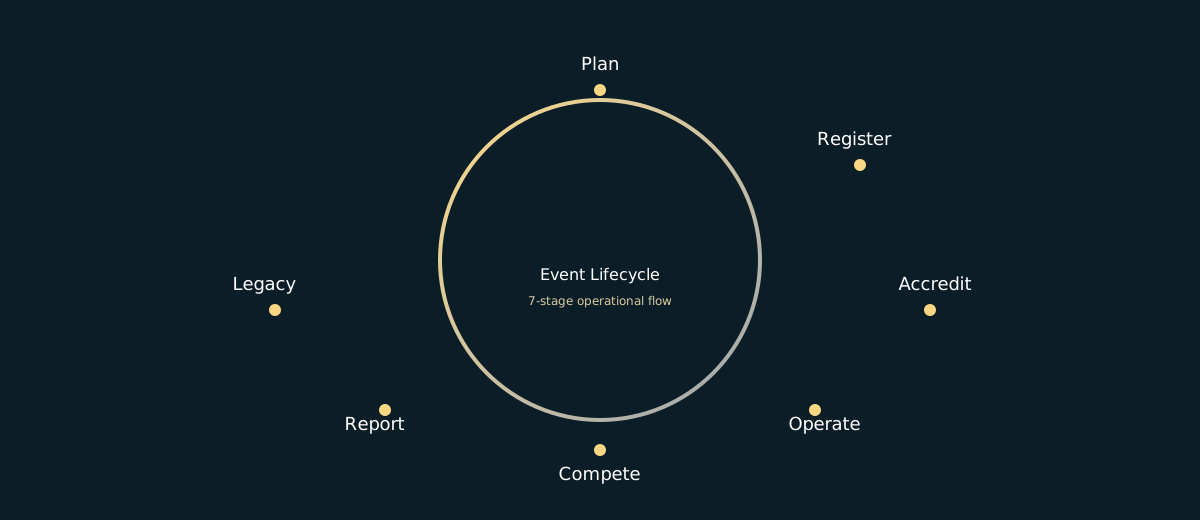
Master planning, schedules, readiness tracking, and cross-functional governance.
Athletes, teams, quotas, stakeholders, validations, and onboarding workflows.
Role matrices, zones, QR credentials, and access governance.
Venues, overlays, transport, accommodation, and workforce deployment.
Competition scheduling, officials coordination, and results management.
Dashboards, monitoring tools, exports, and audit-ready reporting.
Post-event evaluation, documentation, archives, and institutional reporting.

01
Typical outcomes
- Reduced operational risk through readiness tracking
- Faster issue resolution via escalations and logs
- Higher transparency for stakeholders and governance
- Improved on-ground coordination through real-time updates
- Legacy-ready post-event evaluation and reporting